

The challenge
Performance investigations can spread across workload generation, logs, code review, and reporting. Conclusions are useful only when they remain tied to the run that produced them.
The workflow
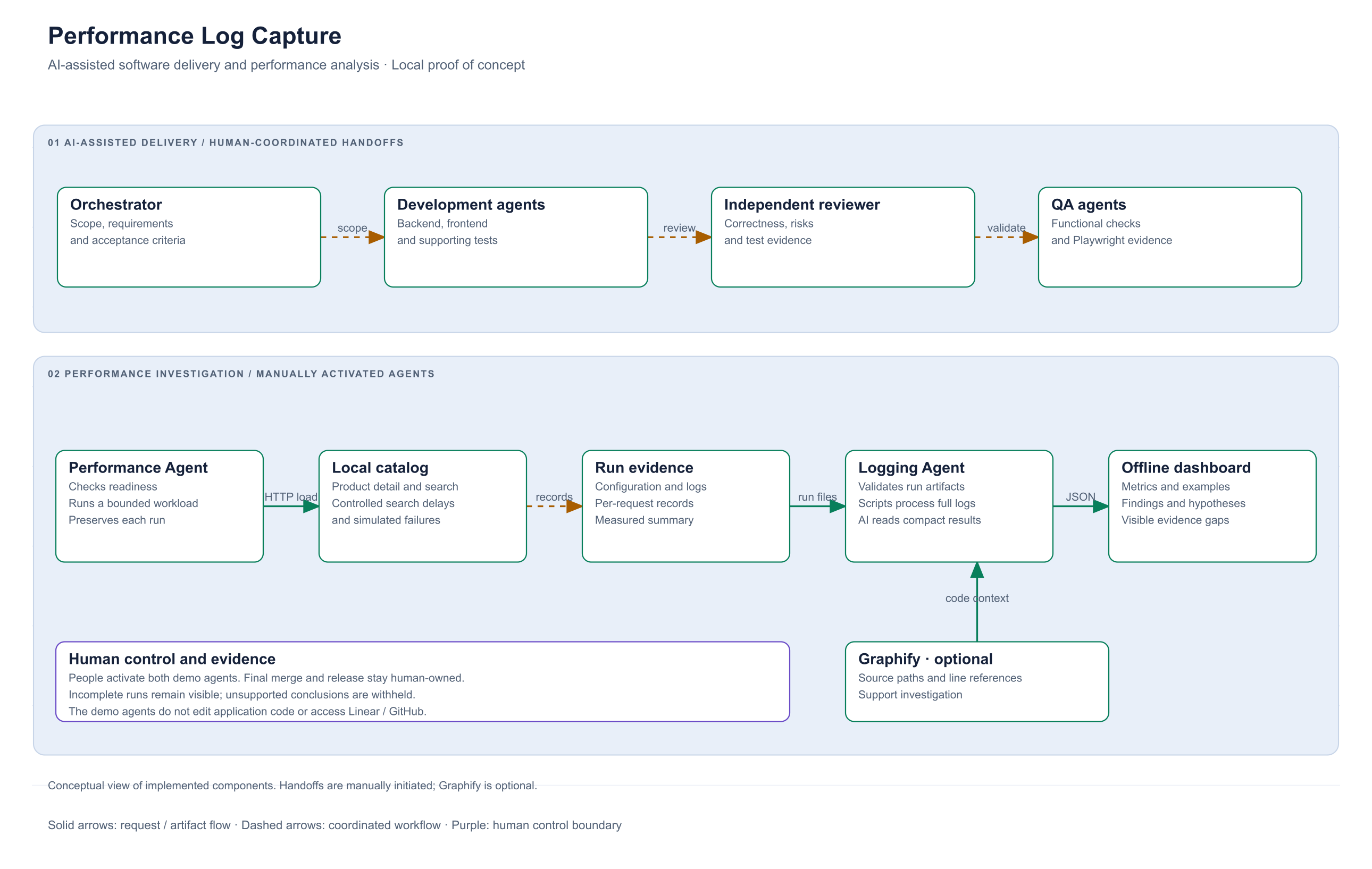
Specialist delivery roles and independent review
A bounded workload with saved run artifacts
Checked files, records, and run identity
An offline dashboard of findings and evidence
A closer look
A performance agent runs a controlled search workload. A logging agent validates the files and summarizes measurements. Missing workload or source-code evidence stays visible in the report.
Evidence & status
- 4,254 requests captured in a preserved run.
- 80 simulated failures over about 60 seconds.
- The run stayed marked incomplete: it did not reach its 20,000-request target.
- Measurements were retained; unsupported derived conclusions were withheld.
Local proof of concept against a catalog with deliberately simulated performance symptoms. The preserved run did not reach its workload target. Production deployment, adoption, and business impact are not established.
An engineering decision
Scripts process large logs before AI analysis. Performance and logging agents run manually; people retain merge and completion decisions.
The opportunity
The opportunity: more reproducible investigations and clearer handoffs between Engineering, QA, and business stakeholders. No production time, cost, defect, or performance gains have been measured.
Adapted from “NAB Oct 2026 — AI Use Cases & Stories.” Statuses and findings reflect that source. Names are listed as project contacts, not credited authors.
Open the project story on LinkedIn