

The challenge
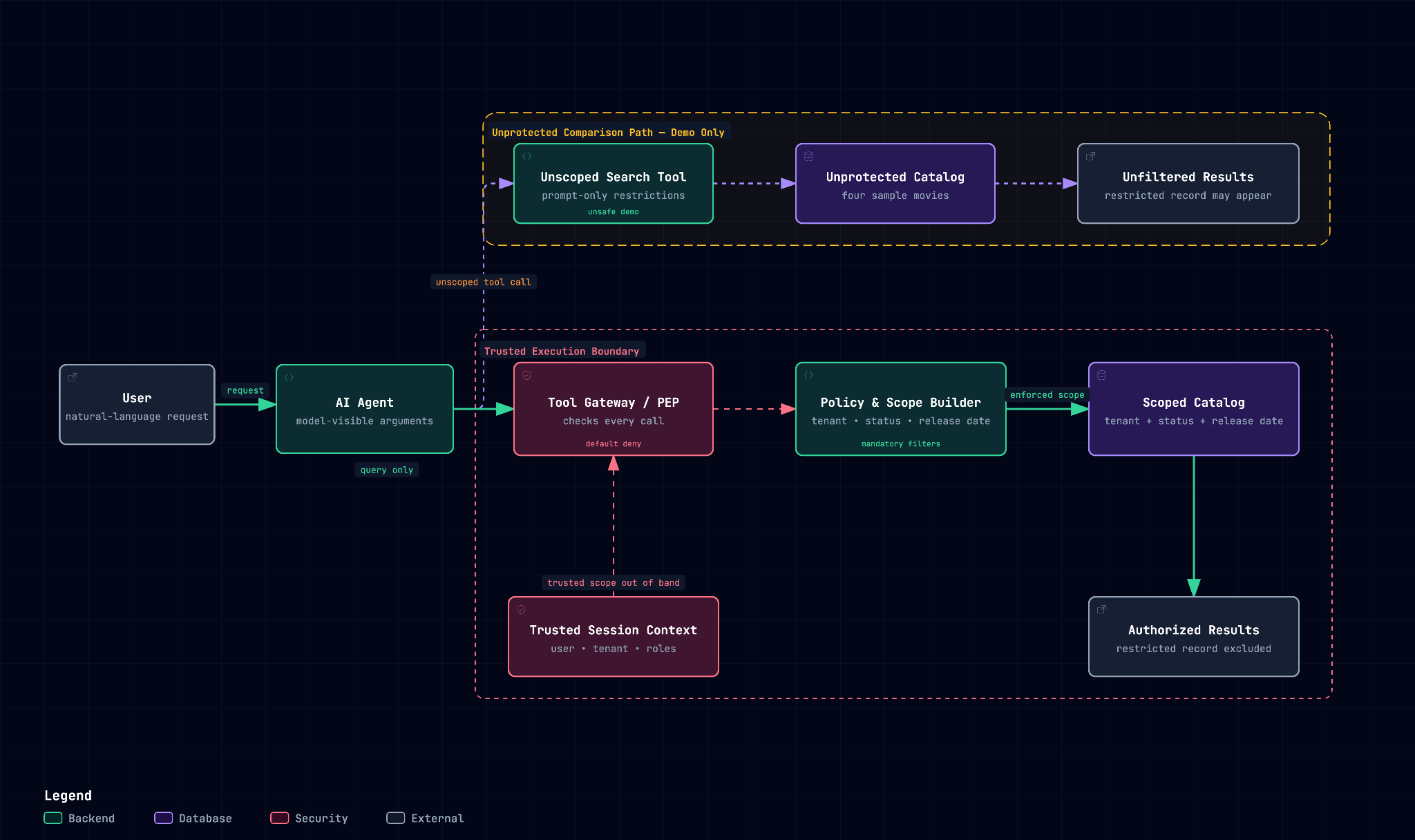
Prompt instructions alone do not enforce authorization. A user could request restricted content or supply arguments that try to broaden a search.
The workflow
Read trusted user and tenant context
Attach context outside model arguments
Apply default-deny policy checks
Add mandatory filters before retrieval
A closer look
A user requests every movie, including unreleased titles, and supplies another tenant ID. Protected search is designed to use the tenant from the trusted session and preserve required release filters.
Evidence & status
- The planned demo compares protected and unprotected search.
- The sample catalog contains four fictional titles, including one restricted item.
- Planned tests cover direct searches, listings, counts, and semantic results.
- Demonstration results and production impact have not been established.
Proposed proof of concept. It does not include a full identity-provider integration, production OAuth, enterprise policy administration, or real confidential content.
An engineering decision
The application derives tenant context from the trusted session and adds required filters outside model-visible inputs. The model cannot relax those controls.
The opportunity
The opportunity: make the boundary between model-generated arguments and trusted application context concrete and reusable. No production or adoption metrics are available.
Adapted from “NAB Oct 2026 — AI Use Cases & Stories.” Statuses and findings reflect that source. Names are listed as project contacts, not credited authors.